
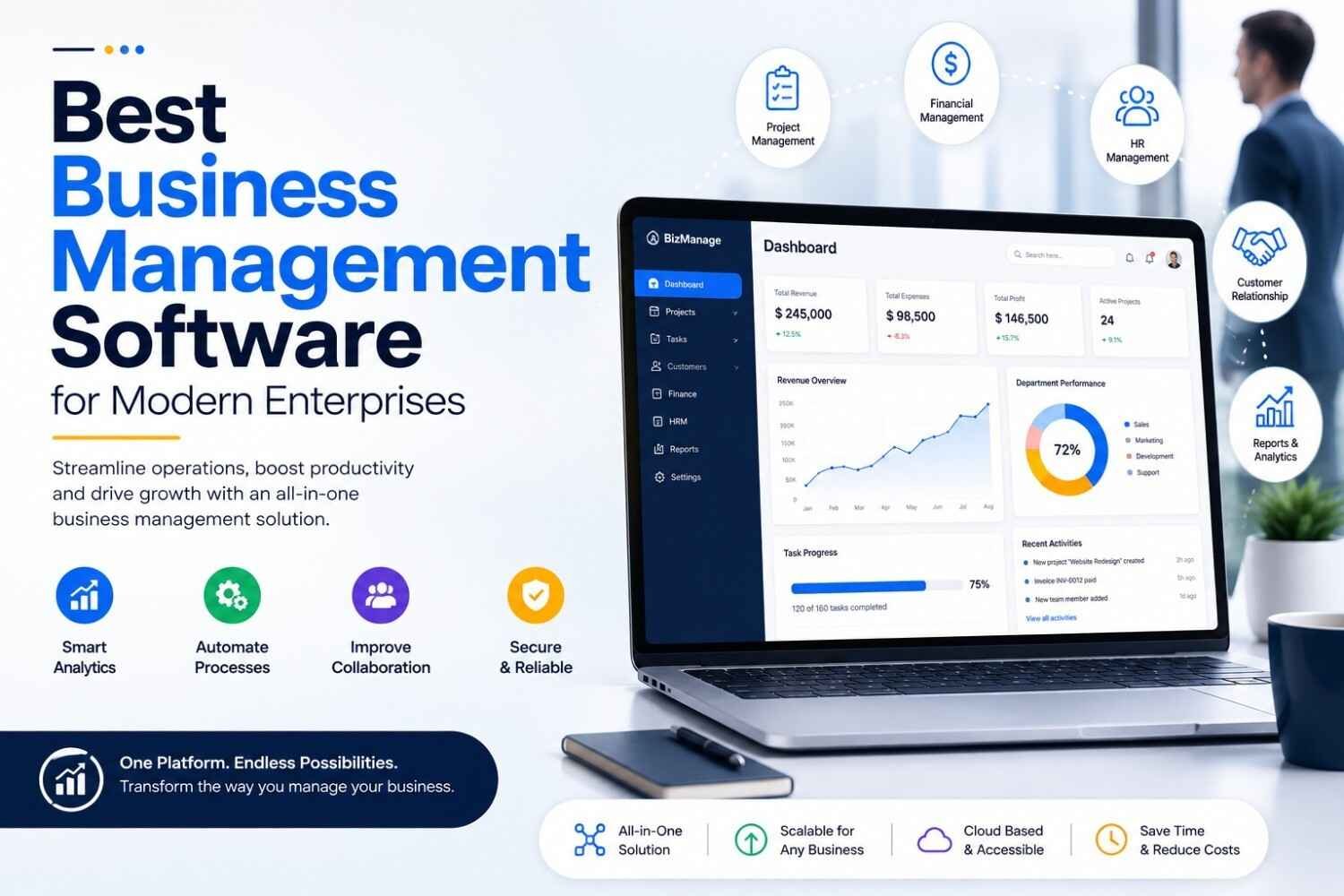
Managing a modern business is far more complex than it was a decade ago. Companies must coordinate finance, sales, customer service, inventory, human resources, marketing, and project management while staying competitive in a rapidly evolving digital economy.
This is where Business Management Software becomes essential. The right platform helps organizations automate repetitive tasks, improve collaboration, reduce operational costs, and make smarter decisions using real-time data.
What is Business Management Software?
Business Management Software is an integrated solution that helps organizations manage their daily operations from a centralized platform. Instead of using multiple disconnected applications, businesses can streamline operations with a single system.
A modern business management platform often includes Customer Relationship Management (CRM), Enterprise Resource Planning (ERP), Accounting & Finance, Human Resources (HR), Payroll Management, Inventory Management, Project Management, Sales Automation, Marketing Automation, Business Intelligence, and Workflow Automation.
The goal is simple: improve efficiency while reducing manual work and operational costs.
Why Modern Enterprises Need Business Management Software
As organizations grow, managing operations manually becomes increasingly difficult. Business management software addresses these challenges by providing centralized control and automation.
Key benefits include improved team collaboration, automated workflows, faster decision-making, better customer experiences, enhanced data security, reduced operating costs, increased employee productivity, accurate reporting and analytics, better compliance management, and scalable business operations.
Key Features to Look For
1. AI-Powered Automation
Artificial intelligence automates repetitive processes such as approvals, scheduling, customer support, and document management. Benefits include faster workflows, lower labor costs, reduced human error, and higher productivity.
2. Cloud-Based Access
Cloud business management software allows employees to work securely from anywhere. Advantages: Remote access, automatic updates, secure cloud storage, and lower infrastructure costs.
3. Customer Relationship Management (CRM)
A built-in CRM helps businesses manage leads, track sales, improve customer service, increase revenue, and monitor customer interactions.
4. Enterprise Resource Planning (ERP)
ERP integrates business departments into one centralized platform. Typical ERP modules include Finance, Procurement, Inventory, Manufacturing, Supply Chain, Sales, and Purchasing.
5. Project Management
Project management tools help teams assign tasks, track deadlines, monitor progress, manage resources, and improve collaboration.
6. Financial Management
Financial modules provide Accounting, Expense tracking, Invoicing, Budget forecasting, Financial reporting, and Tax management.
7. Human Resource Management
HR features include Employee database, Attendance tracking, Payroll, Recruitment, Performance management, and Leave management.
8. Business Intelligence Dashboard
Executives need real-time insights. Dashboards help monitor Revenue, Expenses, Profit margins, Sales performance, Employee productivity, Customer satisfaction, and Inventory levels.
Benefits of Business Management Software
Better Productivity
Automation reduces repetitive tasks, allowing employees to focus on strategic work.
Reduced Costs
Businesses save money by minimizing manual processes and eliminating duplicate work.
Improved Collaboration
Teams across departments work from the same platform, improving communication and transparency.
Better Customer Experience
Integrated CRM systems enable faster responses and more personalized customer interactions.
Faster Decision Making
Real-time analytics help leadership make informed business decisions.
How AI is Transforming Business Management
Artificial Intelligence is changing enterprise software by enabling predictive analytics, automated reporting, intelligent scheduling, AI chatbots, sales forecasting, demand prediction, fraud detection, smart inventory management, and workflow optimization. AI reduces operational costs while improving efficiency and decision-making.
How to Choose the Best Business Management Software
Before selecting a platform, consider business size, scalability, integration with CRM, ERP, email, accounting, payment gateways, and HR software, security features (data encryption, multi-factor authentication, role-based access, compliance support, regular backups), ease of use, and customer support.
Future Trends in Business Management Software
- AI-driven automation
- Low-code and no-code platforms
- Predictive analytics
- Intelligent document processing
- Robotic Process Automation (RPA)
- Voice-enabled assistants
- Hyperautomation
- Advanced cybersecurity
- Cloud-native architectures
- Real-time business intelligence
Frequently Asked Questions
What is Business Management Software?
It is an integrated platform that helps businesses manage operations such as finance, HR, CRM, inventory, projects, and reporting from a single system.
Is cloud-based software better?
Yes. Cloud platforms provide remote access, automatic updates, enhanced scalability, and lower infrastructure costs.
Why is AI important in business software?
AI automates repetitive tasks, improves forecasting, enhances decision-making, and increases productivity.
Which businesses should use Business Management Software?
Small businesses, startups, medium-sized companies, and large enterprises can all benefit from centralized business management solutions.
Conclusion
Modern enterprises require more than spreadsheets and disconnected tools to stay competitive. Business Management Software brings together finance, operations, HR, CRM, project management, and analytics into one unified platform.
By adopting an AI-powered, cloud-based business management solution, organizations can streamline operations, improve collaboration, make data-driven decisions, and position themselves for long-term growth. Whether you're a startup scaling quickly or an established enterprise modernizing your processes, investing in the right business management software is a strategic step toward greater efficiency, productivity, and sustainable success.